
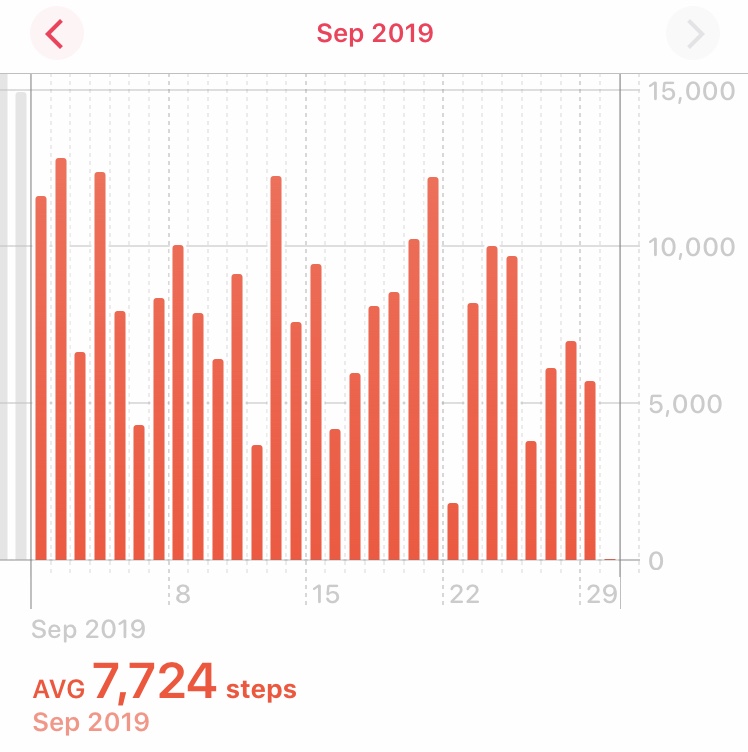
For my project I decided to go with tracking the steps I took over a two-week time period. During this time, I learned a lot about how much a daily walk can help a person relax and just take a minute to enjoy the world around them. One thing in class that is like the walking exercise I’ve been following for the past couple months is the Wednesday medication. Although during the Wednesday medication we aren’t doing a physically activity, it really helps clear my mind and allows me to take a moment to just relax and enjoy the moment, which is exactly what my walking exercise allows me to do.
This project has also been fun to complete, while learning in class how to track our data in the most effective ways, I was able to track all my necessary data. For this project I used Apple’s Health app which is free to use under the terms and conditions that the user allow Apple to track information about the them, personally I didn’t find the information I was giving Apple too important so I just skimmed past the terms and just accepted them. The project examples that were showed in class helped motivate me to make mine different than others, and while we did our peer reviews, I was able to see others project drafts and learn from them. One main thing that helped me complete this project was some of the ideas I got from others in the class. Lots of the people I met with had great feedback to give me, and while using this feedback I was able to create a final product that was a lot more complete than I imagined it would be post draft. It was also nice to help give classmates ideas on how to improve their drafts and add more creativity to their projects.
Apple’s Health app tracks a lot of things, not just your steps, but the idea of calculating each step a person takes for every day is a great idea, but also weird at the same time. Like some of the tracking topics we talked about in class, this app can see what days you’re most active, and if you add an Apple Watch to the equation, it’ll add even more features. Unfortunately, I don’t have an Apple Watch yet, but I do find it somewhat weird the app can calculate the number of steps and stairs climbed to an accurate number (if you have your phone on you and charged). Some articles we talked about in class that tracked data like the target topic, I found weird since I don’t personally like being tracked, but when tracking myself I found it interesting because it just showed me how active I was being on certain days. I also was amused by the difference in everyday moods after longer walks. I found these walks to be beneficial to my mental health, physical health, and even improved my sleeping patterns. These positive improvements help motivate me to keep going on these walks, and they also help me maintain a healthy lifestyle.
In class we talked about how to make an effective and accurate graph that fits our tracked data and organizes it to make it easy for everyone to understand. Some of the graphs I saw were hard to follow and the original one I made was hard to follow as well. After going over good graphs in class I was able to construct a graph that fits my project in the most simple, effective, and accurate way, which I would consider a good graph since it has all of the key elements. Another thing that I made my graph include was a simple color way since it wasn’t too distracting and had a clean design to it. It was easy making the x and y axis since the day we looked at bad graphs I noticed most of them weren’t easy to understand due to the weird values the included. After seeing the bad graphs, I learned exactly what not to do, and concluded that keeping a simple graph was the way to go. Also, the bar graph fits nicely with the type of data I was collecting.
The “CRAP” method we discussed in class, played a big contribution to the way I created my project. Since I knew that not involving the CRAP method within my project would result in a bad grade, I knew I had to follow it strictly. With that said, I thought about which components of the CRAP method were most important to me and I prioritized them first. Contrast being the most important to me, allowed me to create a story with my poster. With the graphs being the biggest items on the poster, and the small font paragraph easy enough to read, small enough to not grasp all the audience’s attention, and lastly the little art I decided to add all came together to form my ideal poster. The repetition of color I decided to follow was a nice black and white, with the accent color being orange, unfortunately when I printed the graphs out they came out more red, and I personally thought the orange looked a lot nicer, but at the same time the red was a good touch to add. When it came to alignment, I knew that my project would be easy to align in order to get my point across, so I added the graph from the 1st week first, and then put the 2nd week right after it. With the title at the top, I added the text explaining my data tracking project right below it in a small font, after that was all together I realized I had a lot of blank space and decided to cut the shape of stairs on my poster board using a knife which wasn’t too easy, but the final product came out ok. Lastly, I had a bunch of blank space and wanted to fill it in with something related to my topic, so I added in the shoe to finish it off. I didn’t think too much about proximity, but since I had the contrast, repetition, and alignment, it was almost like the proximity for all my pieces was perfect the way it way. Without the CRAP method, my project would’ve turned out a lot less organized, and I’m glad I was able to learn and execute this so smoothly on my first try.
For my project I wanted to show how video games have changed overtime, not for the better, and not for the worse, but just changed in general. I chose video games since they’ve always been a part of my life, and they’re also a technology that brings people together which I find fascinating. Since the start of my childhood, I’ve noticed that video games have always been big news when they’re released, or maybe there’s a new system coming out and lots of people want to be the first to get it. This is due to the new content and experiences you can get from newer games. With that being said, it may seem like an argument being made about newer gaming being better/more important than past gaming, but that isn’t true at all. Every year, games do change in large amounts, but a lot of the concepts within the games will stay the same. So, although there may be a new game coming out each year for a certain series, that won’t stop players from going back and experiencing an old memory, which brings me to my next point.
Since gaming has been around for such a long time that almost everyone you’ve met has experienced some sort of gaming experience, it’s something that can bring people together. Older games such as; Mario, Tetris, and Asteroids are games that have been around for sometime, and that doesn’t stop these games from being some of the most popular, cultural changing experiences of all time. Even now, in today’s time, these games are being remade with different graphics and styles of playing, but this still doesn’t take away from the feeling of playing the original versions.
For my piece I created a side by side comparison of what gaming looked like in the past, and how it is at its current stage. Each side of the spectrum ranging from old to new has plenty of fans who have a love for it. Each side also offers unique styles of playing that have changed gaming culture for good, and no side has more love than the other, although games and consoles may be similar, each and every game/console you play offers a unique experience you can’t get with other options. That’s why as time goes on, old games and new games will still be relevant and continue to grow, and they’ll bring the entire gaming community together as one.
Part 1-
Ceiling fans are one of our best friends in the summertime, providing air circulation throughout our house and rooms. But even these luxury items have faults in them that cause inconveniences. I interviewed several people, friends, family and strangers around WSU on the problems they face with traditional ceiling fans. In every interview all of our participants brought up the inconvenience of not being able to tell what speed the fan is on when pulling the sting. “Everytime I turn my fan on I have to start with it turned off and then listen for the speed I want, ” many of my participants said. This is an inconvenience that is a time waster and prevents you from quickly doing a simple job. This type of problem does not pertain to a specific group of humans, this is a struggle that we have all dealt with one time in our life or another. We first have to understand the frustration of those people and see what material would help them use their fans easier. This is where our team steps in, a traditional ceiling fans controls are too simple of a design that lacks things such as user feedback and convenient features. My group and I have made it our goal to come up with a new tool that redesigns how you use your ceiling fans.
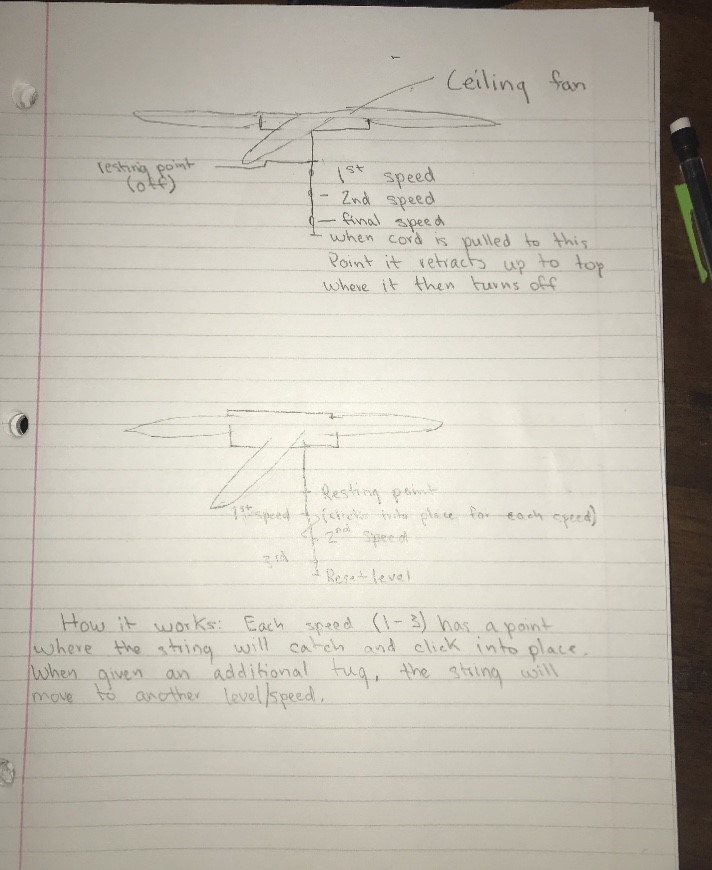
This new design will help eliminate the inconvenience of your unawareness of the fan setting, giving you feedback so you are always certain what speed the fan is spinning. This simple re-design consists of a replacement string that is retractable and has different length settings. For example, when the fan is off our new string is at its highest point, when pulled once it goes down one level then stops, second pull puts it at the second level, and the third to the third level. This adds the feature of user feedback, each different length of the string has a color on it to also indicating the level.
Part 2-
After doing some research, we thought about the product that needed changing in our everyday lives, and while we were brainstorming, the idea of ceiling fan strings came across our minds. Since we already interviewed people and found out the main problem with them, we had to go back and now create a solution. These ceiling fans can be tricky to tell if you’re turning them off, or if you’re turning up the power on them more. With that said, we created a string design that can be attached to a fan making it simpler to tell which level of power you’re at, and when you’ve officially turned it off. During our first design, the product was a little rough. We didn’t have a solid idea on how to create a product that wasn’t already out yet, and with ceiling fans there are many different types. While we brainstormed an idea on how to make a ceiling fan easier to understand, we had the idea of having a retractable string that would click on 3 different speed settings. This original design didn’t have an indicator of whether or not the different speed has been achieved, so we had to go back and add more to our design making it the most user friendly and easy to understand product out there.
Since our first idea didn’t fully make the product as simple as we wished, we knew the idea wouldn’t be complete without another signifier. So, we went back, polished our idea up, and created the final product of having a string that had 3 different speed settings, with a clicking sound that indicates each speed you’re fan is at. Then once you’ve cycled through all 3 speeds, the string will then go back up and restart at its point of origin. After we brainstormed this idea, we knew there wasn’t much more we could change that would make the product any more simple, and that’s how we knew that our designed prototype was the perfect fit.
Part 3- As we looked back at our final design, we were all satisfied with the outcome, as well as some of the people we interviewed afterwards asking them if they liked the idea or not. The simple string added to the ceiling fan created a huge difference in their eyes, and that’s what our final goal was. With this addition to ceiling fans, we hope to eliminate the confussion for those wondering what speed/power their fans are on for good. Personally, we believe that this addition will impact culture by taking away the amount of time it takes to figure a simple task of getting the right speed on the fan. We understand the general emphasis on high-tech. But as Victor (2011) put it in the article “A Brief Rant on the Future of Interaction Design”, on top of the technology, we can always add something dynamic to the target object, so that users can “feel and manipulate” the upgraded medium. We find that there are certain apps used in companion with the set of devices for “smart home” that enable users to control the indoor temperature or precisely the speed of fans. However, we think that the whole experience can be more tangible and the purpose of controlling the speed can be transmitted in a more elegant, simpler way. With a clicking sound, our design can let the users feel in control. Apps may be convenient and in trend, but a string is more straightforward, which is more easy to understand after learning more through the article “The Design of Everyday Things” where “visual metaphor” play key rolls in showing objects can be easier to use.
 Blake Schaffer's
Leave a comment